
If you’ve been searching for information on disability benefits, you’ve probably run into two very different acronyms being used almost interchangeably SSD and VA disability. It’s an easy mix-up to make, especially for veterans who may be eligible for both at once, but understanding what is SSD VA disability really means starts with recognizing that these are two completely separate federal programs, each with its own rules, its own definition of disability, and its own application process.
This guide is written for veterans, civilian workers with disabilities, and family members trying to make sense of these benefits on someone else’s behalf. By the end, you’ll have a clear, plain-language understanding of how each program works, how they differ, and importantly how they can work together rather than against each other.
What Is Social Security Disability (SSD)?
Social Security Disability, often shortened to SSD, is a federal benefit program run by the Social Security Administration, or SSA. It exists to provide monthly income to people whose medical condition is severe enough to prevent them from performing substantial work, regardless of what caused that condition. Unlike VA disability, SSD has nothing to do with military service — anyone who meets the medical and work-history requirements can qualify, whether their disability resulted from an illness, an accident, a chronic condition, or anything else.
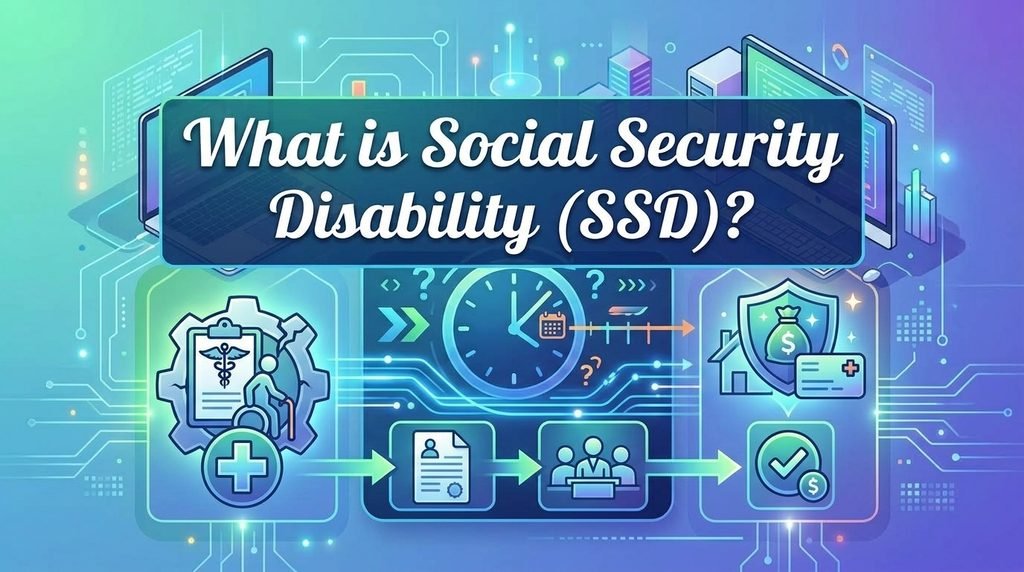
There are actually two distinct programs that fall under the SSD umbrella: Social Security Disability Insurance, known as SSDI, and Supplemental Security Income, known as SSI. Both are administered by the SSA, but they work quite differently, which we’ll break down further in Section 5.
What Is VA Disability?
VA disability compensation, on the other hand, is administered by the Department of Veterans Affairs and is available exclusively to veterans whose injuries or medical conditions are connected to their military service. This is often referred to as being “service-connected,” meaning the condition either began during service or was made worse by it.
Rather than requiring a veteran to be completely unable to work, VA disability is based on a percentage rating system that reflects how much a condition impacts daily functioning. This means a veteran can be working a full-time job and still receive VA disability compensation for a service-connected condition, which is one of the biggest distinctions between the two programs.
SSD vs VA Disability: Core Differences
Eligibility requirements SSD eligibility hinges on medical severity combined with an inability to perform substantial gainful work, along with sufficient work history for SSDI specifically. VA disability eligibility hinges on proving a condition is connected to military service, regardless of whether that condition currently prevents someone from working.
Who qualifies Any civilian or veteran can apply for SSD, as long as their disability meets SSA’s medical criteria. VA disability, by contrast, is reserved specifically for veterans with qualifying service and a documented service connection.
Definition of “disability” under each system SSA defines disability as a condition severe enough to prevent any substantial gainful activity for at least 12 months. The VA defines disability more broadly, in terms of the degree to which a service-connected condition impairs a person’s overall functioning, even if they’re still capable of working.
Ability to work while receiving benefits This is one of the clearest differences. SSD generally requires that you not be performing substantial work above a set monthly earnings threshold. VA disability places no such restriction — you can work full-time and still receive your full VA rating and compensation.
Comparison table
| Factor | SSD (SSDI/SSI) | VA Disability |
| Administered by | Social Security Administration | Department of Veterans Affairs |
| Who can apply | Any eligible civilian or veteran | Veterans only |
| Requires service connection | No | Yes |
| Can you work while receiving it? | Generally no (above SGA limit) | Yes |
| Rating system | Approved/denied (not percentage-based) | 0–100% rating scale |
| Based on work history | Yes, for SSDI | No |
Types of Social Security Disability
SSDI (Social Security Disability Insurance) SSDI is funded through payroll taxes and is available to people who have worked and paid into Social Security long enough to earn sufficient work credits. The monthly benefit amount is calculated based on your past earnings, similar to how a retirement benefit is calculated, meaning higher lifetime earnings generally translate to a higher monthly SSDI payment.
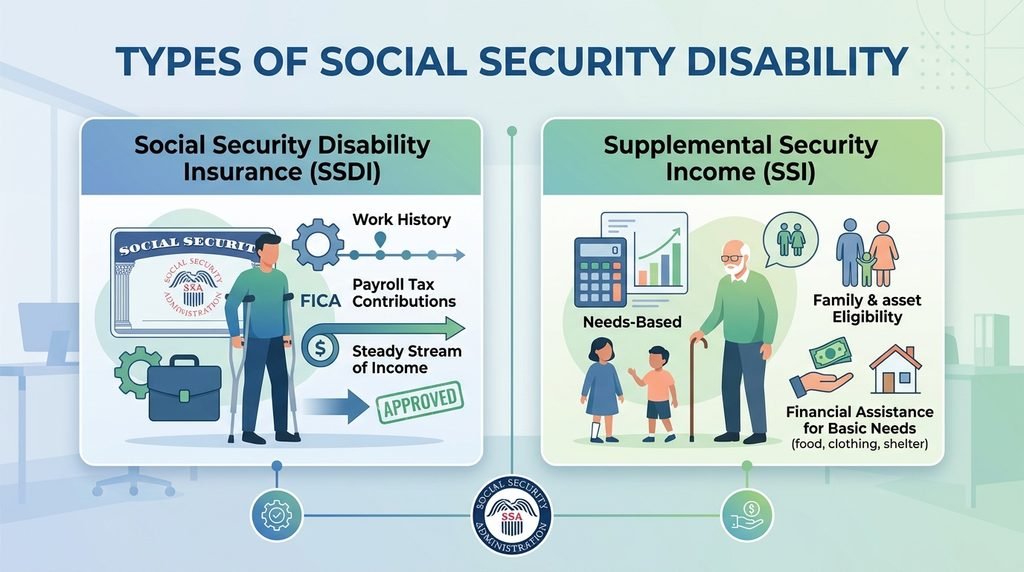
SSI (Supplemental Security Income) SSI, on the other hand, is a needs-based program that doesn’t require any work history at all. Instead, eligibility is based on limited income and financial resources, making it available to disabled individuals, including children, who haven’t worked enough to qualify for SSDI or who have very limited financial means.
How VA Disability Ratings Work
The VA uses a rating scale that runs from 0% to 100%, assigned in 10% increments, based on the severity of each service-connected condition. When a veteran has more than one qualifying condition, the VA doesn’t simply add the percentages together; instead, it uses a combined ratings formula that accounts for how conditions overlap, which typically results in a combined rating somewhat lower than a simple sum would suggest.
The higher the combined rating, the higher the monthly compensation a veteran receives, and additional amounts may be added for dependents at higher rating levels. A veteran rated 100% Permanent and Total, often abbreviated as P&T, is considered to have a service-connected disability that is both totally disabling and not expected to improve.
| Approximate Rating | General Monthly Compensation Level |
| 10%–20% | Lowest tier, no dependent adjustments |
| 30%–60% | Mid-range, dependent adjustments may apply |
| 70%–90% | Higher tier, significant dependent adjustments |
| 100% | Highest tier, full compensation plus dependent benefits |
Because VA compensation rates are updated periodically and vary based on dependent status, it’s best to check the VA’s official rate tables for exact current figures rather than relying on a fixed dollar amount.
Eligibility Requirements Compared
SSD eligibility criteria To qualify for SSDI, you generally need a sufficient number of work credits earned through recent employment, along with a medical condition expected to last at least 12 months or result in death, and evidence that this condition prevents substantial gainful work. SSI instead focuses on financial need rather than work history.
VA disability eligibility criteria To qualify for VA disability, you need to have served on active duty, active duty for training, or inactive duty training, generally with a discharge status other than dishonorable, along with medical evidence connecting your current condition to an event, injury, or illness that occurred during or was aggravated by your service.
Overlapping vs distinct requirements While the two programs don’t share eligibility requirements directly, medical evidence gathered for one claim can often support the other. A strong VA claim file, for example, can provide valuable medical documentation that strengthens an SSD application.
How to Apply for Each Benefit
- Applying for SSD Applications for SSDI and SSI can be submitted online through the SSA’s website, by phone, or in person at a local Social Security office. The process requires detailed medical documentation, work history information, and a description of how your condition limits your daily functioning. Initial decisions can take anywhere from a few months to well over a year, and many claims require an appeal before ultimately being approved.
- Applying for VA Disability VA disability claims are filed through the VA’s official claims system and typically require a Compensation and Pension exam, often called a C&P exam, where a VA-approved medical examiner evaluates your condition. Supporting evidence such as service treatment records, private medical records, and buddy statements from fellow service members can all strengthen a claim.
- Typical processing timelines SSD claims often take several months at the initial stage alone, with total resolution — including any appeals — sometimes stretching well over a year. VA disability claims can also take several months, though certain fast-track programs, discussed in Section 9, can significantly shorten this timeline for qualifying veterans.
Can You Receive Both SSD and VA Disability?
Yes — veterans can receive both VA disability compensation and Social Security Disability at the same time, since these are entirely separate federal programs that don’t offset one another. VA disability compensation is treated as unearned income by the SSA, and because SSDI eligibility is affected only by earned income from work, receiving VA compensation has no impact on your SSDI payment amount.
Veterans rated 100% Permanent and Total by the VA also qualify for expedited processing of their SSDI claim, a policy the SSA has had in place since 2014. This same fast-track treatment also applies to veterans injured on active duty on or after October 1, 2001, under what’s known as the Wounded Warrior program. To request this expedited handling, veterans should clearly note their VA rating status in the remarks section of their SSDI application and include a copy of their official VA rating decision. It’s worth noting, though, that a 100% VA rating speeds up the review process but doesn’t guarantee SSDI approval, since the SSA applies its own separate medical and vocational standards to every claim.
Payment Amounts: SSD vs VA Disability
SSD payment amounts differ significantly depending on the program. SSDI payments are based on your individual earnings history, meaning two people with different lifetime incomes will typically receive different monthly amounts. SSI payments, by contrast, follow a more standardized federal base rate that can be reduced depending on other income or resources.
VA disability payments are determined by your combined disability rating and are further adjusted based on how many dependents you have, such as a spouse or children. Both programs typically receive periodic cost-of-living adjustments, or COLA increases, which are announced annually and applied to keep pace with inflation. Because exact dollar figures change from year to year, checking the SSA and VA’s official websites is the most reliable way to see current payment amounts.
Common Misconceptions About SSD and VA Disability
“VA disability automatically qualifies you for SSD.” This isn’t accurate. While a high VA rating can serve as strong supporting evidence, the SSA conducts its own independent medical and vocational review before approving any SSD claim.
“You can’t receive both.” This is also false. As covered above, veterans are fully permitted to receive both VA disability compensation and SSDI simultaneously, without either benefit reducing the other.
“A 100% VA rating means automatic SSD approval.” While a 100% Permanent and Total VA rating does qualify a veteran for expedited SSD processing, it still does not guarantee approval, since SSA continues to apply its own distinct disability criteria to every application it receives.
Special Programs Connecting the Two
Beyond the expedited processing available to 100% P&T veterans and Wounded Warriors, military service records and VA documentation can play a meaningful supporting role in an SSD application even outside these specific fast-track categories. Detailed VA medical records, C&P exam results, and service treatment records can all help paint a clearer picture of a veteran’s functional limitations for SSA reviewers.
It’s generally a good idea for veterans pursuing both benefits to keep documentation from each application consistent and up to date, since inconsistencies between the two claims can sometimes slow down either review process.
Appeals Process for Both Programs
If an SSD claim is denied, applicants can move through several stages of appeal, starting with reconsideration, followed by a hearing before an administrative law judge, and potentially further review by the Appeals Council or federal court if necessary. This process can take a considerable amount of time, sometimes well over a year depending on backlog in a given region.
VA disability claims that are denied or rated lower than expected can also be appealed, typically through a Higher-Level Review, a Supplemental Claim with new evidence, or an appeal directly to the Board of Veterans’ Appeals. Each path has different timelines and requirements, and choosing the right one often depends on whether new evidence is available to support the claim.
Frequently Asked Questions
Is SSD the same as VA disability? No. SSD is a federal program for anyone with a qualifying disability, run by the Social Security Administration, while VA disability is exclusively for veterans with service-connected conditions, run by the Department of Veterans Affairs.
Can I get SSD if I already receive VA disability? Yes, receiving VA disability does not prevent you from also applying for and receiving SSD, since the two programs are entirely separate and don’t offset each other.
Does a 100% VA rating guarantee SSD approval? No, but it does qualify you for expedited SSD processing, meaning your claim will typically be reviewed faster, even though approval still depends on meeting SSA’s own criteria.
Which pays more, SSD or VA disability? It varies widely case by case, since SSDI depends on your individual work and earnings history, SSI depends on financial need, and VA disability depends on your combined disability rating and number of dependents.
Can veterans apply for both at the same time? Yes, veterans are free to apply for VA disability and SSD at the same time, and many veterans do pursue both applications concurrently.
Does working part-time affect either benefit? It can affect SSD, since earning above the SSA’s substantial gainful activity threshold may impact eligibility, while VA disability compensation is not affected by employment status or income at all.
Conclusion
So, what is SSD VA disability, in the simplest terms? They’re two distinct disability benefit systems that are often mentioned together but operate under completely different rules SSD focuses on whether a medical condition prevents you from working, regardless of its cause, while VA disability compensates veterans for service-connected impairments regardless of whether they’re still able to work.
For veterans, the encouraging news is that these programs are designed to work alongside each other rather than in competition, and qualifying for one doesn’t disqualify you from the other. Given how detailed and document-heavy both application processes can be, it’s often worth consulting directly with the SSA, the VA, or a qualified disability attorney or accredited veterans service officer to make sure your specific situation is handled correctly from the start.
Related Post:
Is There a Side Effect to Low Power NVMe SSD? A Complete, Easy-to-Understand Guide
Is 512GB SSD Enough? A Complete Guide for Every User Type
1TB vs 2TB SSD: Which One Do You Actually Need?