
Shoot one long day of 4K video on your iPhone 17 Pro Max and you’ll watch that storage bar creep toward red faster than you’d think. It’s not a phone problem exactly it’s a video file size problem. That’s why so many creators end up typing “external SSD for iPhone 17 Pro Max” into Google at 11 PM, usually right after a “storage full” warning ruins a shoot.
This guide skips the fluff. You’ll get real buying criteria, honest picks, a setup walkthrough, and a few mistakes worth avoiding the kind of stuff most buying guides gloss over.
Why You’ll Probably Need an External SSD for iPhone 17 Pro Max
Here’s the math nobody tells you upfront: a single minute of 4K ProRes footage can eat up around 6GB. Multiply that by a two-hour shoot and you’ll understand why even a 1TB phone starts feeling small.
An external SSD for iPhone 17 Pro Max solves this the boring, reliable way you just plug in more storage instead of deleting last week’s footage to make room for today’s. No app tricks, no compression that hurts quality, no juggling between iCloud and local files mid-shoot.
There’s a side benefit too. Once you own a solid external SSD for iPhone 17 Pro Max, you don’t need to pay Apple’s premium for the 2TB internal tier every time you upgrade phones. The drive just moves with you to the next device.
It’s also worth saying plainly: not everyone needs one. If you shoot the occasional TikTok clip or family video, your phone’s built-in storage is probably fine. But the moment you start editing multi-take projects, shooting log footage for color grading, or filming anything longer than a few minutes at 4K60 and above, that’s when a dedicated external SSD for iPhone 17 Pro Max starts paying for itself.
The Storage Problem Nobody Warns You About: ProRes RAW
Apple upgraded the iPhone 17 Pro Max to USB 3.2, which is roughly ten times faster than the old USB 2.0 port on non-Pro models. That upgrade is the whole reason a fast external SSD for iPhone 17 Pro Max is even worth buying now — the phone can finally keep up with a proper SSD’s speed.
But here’s the part that catches people off guard: if you want to shoot ProRes RAW, Apple won’t let you record it to internal storage at all. It only writes to an external drive. Try it without one connected, and the option simply isn’t there.
[Internal Link: How to Free Up iPhone Storage Without Deleting Photos]
ProRes RAW is hungry, too — expect 4GB to 5GB per minute of footage. A full day of shooting can chew through 300GB without much effort, which means even a maxed-out 2TB iPhone would run dry in six to eight hours of continuous recording. If you shoot for a living, an external SSD for iPhone 17 Pro Max isn’t a nice-to-have anymore. It’s part of the kit.
What to Check Before Buying an External SSD for iPhone 17 Pro Max
Not every drive on Amazon will actually work well for this. A few things separate a good external SSD for iPhone 17 Pro Max from one that’ll frustrate you mid-shoot.
Write Speed — This One Actually Matters
For 4K60 ProRes, you need at least 220MB/s of sustained write speed from your external SSD for iPhone 17 Pro Max. Bump up to 4K120, and that number doubles to 440MB/s. Note the word “sustained” — a drive that hits 1000MB/s in a burst but drops off after ten seconds will still choke mid-recording. Cheap USB flash drives and old spinning hard drives just can’t hold that pace.
exFAT Formatting Isn’t Optional
Your external SSD for iPhone 17 Pro Max needs to be formatted in the file system built to handle large video files without the size caps older formats impose. Most drives ship exFAT out of the box, but it’s worth checking before you buy — and skip anything password-encrypted, since Apple doesn’t support that at all.
Magnetic vs. Cable-Based Design
Magnetic drives snap onto the back of your phone MagSafe-style, so there’s no cable flapping around while you film. Cable-based drives are usually cheaper and often faster for sustained heat management, since they’re not squeezed against a warm phone. Pick based on how you actually shoot, not on which looks cooler in photos.
The Cable You Use Matters Too
The iPhone’s port is only as fast as the cable plugged into it. A bargain-bin cable rated for charging only will bottleneck even the fastest external SSD for iPhone 17 Pro Max. Look for one explicitly rated at 10Gbps or higher.
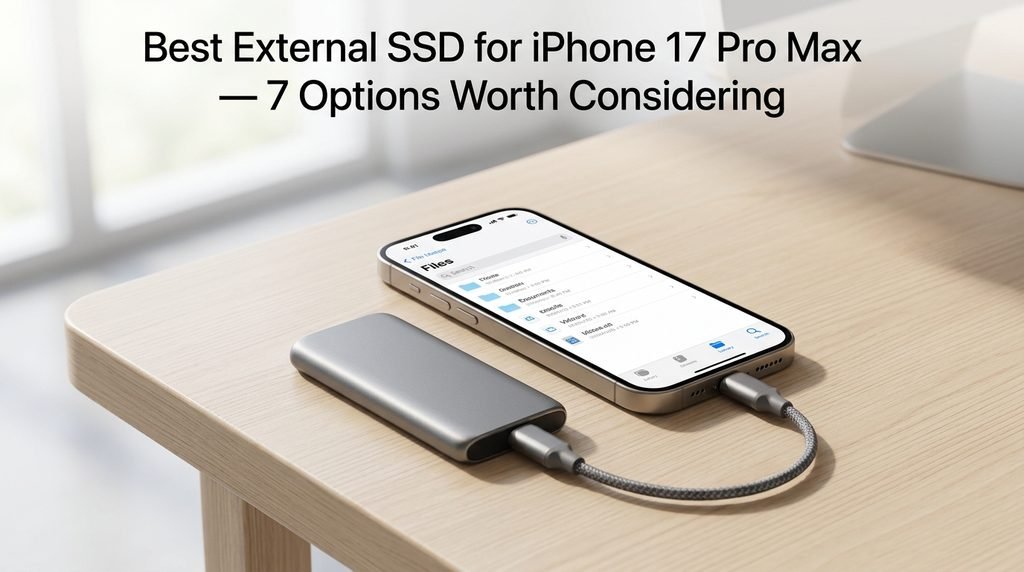
Best External SSD for iPhone 17 Pro Max — 7 Options Worth Considering
Rather than pushing one “best” drive, it’s more useful to know which category fits your actual shooting style. Here’s how the current market breaks down.
Best for ProRes RAW Work
Look for magnetic drives rated above 1000MB/s sustained, with a built-in cooling fan. Without active cooling, longer takes can throttle and trigger that dreaded “Slow Recording Speed” warning mid-take. This is the category most serious videographers should focus on when comparing external SSD for iPhone 17 Pro Max options.
Best Magnetic Option
If you shoot handheld or run-and-gun, a magnetic mount keeps your rig cable-free and pocketable. It’s the difference between fumbling with a dangling wire and just grabbing your phone and going.
Best for Outdoor and Travel Use
Drives rated IP65 or IP66 handle dust and light rain without flinching, and some survive drops from a couple of meters. Worth the extra cost if your shoots involve anything other than a clean studio floor.
Best Budget Pick
A 256GB to 512GB drive covers casual video work and photo backups without draining your wallet. It won’t handle a full day of ProRes RAW, but for most weekend creators, it’s plenty.
Best High-Capacity Option
For anyone shooting long-form or ProRes RAW regularly, 2TB or more is where you stop worrying about running out mid-project. It costs more upfront but saves you from constantly offloading footage on location.
Best Hub-Combo Drive
Some external SSDs double as a USB-C hub, letting you connect a mic, lights, and a charging cable through one unit. Useful for podcast setups or studio recording where you’re plugging in more than just storage.
Best Everyday All-Rounder
If you just want reliable backup storage that also works with your Mac or PC, a mid-range 1TB drive without any fancy magnetic mount usually does the job fine, and costs less than the specialty options.
[Internal Link: Best MagSafe Accessories for iPhone 17 Series]
Brands Worth Knowing
A handful of names keep showing up in this space. Lexar’s magnetic lineup leans into ProRes RAW recording with strong sustained speeds and active cooling. SanDisk and Crucial both offer USB 3.2 Gen 2 portable drives with long warranties — five years, in some cases — which says something about how confident they are in their build quality.
Newer players like ACASIS and Orico are building magnetic NVMe enclosures specifically tuned for the iPhone 17 Pro Max’s USB 3.2 port. These let you drop in your own NVMe chip, which can work out cheaper than buying a pre-built drive if you already have compatible storage lying around. Since new models launch constantly, it’s worth checking recent reviews rather than trusting a spec sheet from six months ago.
How Much Storage Do You Actually Need?
If you’re an occasional vlogger, 512GB will carry you fine. Regular ProRes RAW shooters should think in terms of 1TB to 2TB. A decent rule of thumb: the longer and heavier your shoots get, the more that extra capacity stops feeling optional and starts feeling necessary — wedding and event videographers often treat 2TB as their baseline, not a luxury.
A Quick Reality Check on Pricing
Prices on an external SSD for iPhone 17 Pro Max swing a lot depending on brand and capacity. A basic 512GB cable-based drive from a lesser-known brand might run you under $60, while a 2TB magnetic drive with active cooling from an established name can climb past $200. That gap usually comes down to sustained write speed, build quality, and whether you’re paying for a fan and an LCD status screen you might never actually look at.
It’s tempting to grab the cheapest option that mentions “iPhone compatible” on the box. Don’t. A drive that can’t sustain 220MB/s will interrupt your recording with an error mid-shot, and by then you’ve already lost the take. Spend on the spec sheet, not the marketing copy.
Setting Up Your External SSD for iPhone 17 Pro Max
The setup itself takes about a minute once you know the steps.
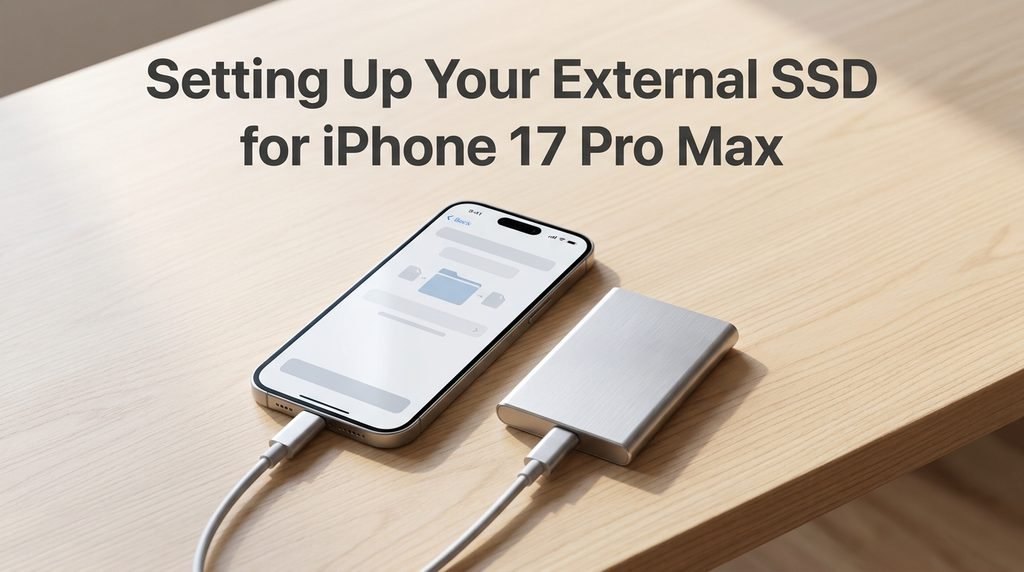
- Connect your external SSD for iPhone 17 Pro Max using a USB-C cable rated for at least 10Gbps.
- Open the Files app — the drive should show up automatically under “Locations.”
- To record ProRes, open Camera, go into Video settings, and enable ProRes mode.
- With the drive connected, you’ll see an “EXT” indicator in the camera interface, confirming footage is writing to the external drive, not your phone.
- When you’re done, always eject the drive properly through Files (tap and hold, then Eject) before unplugging the cable.
External SSD vs. iCloud vs. Paying for More Internal Storage
This is the comparison most buying guides skip entirely, and it’s honestly the one that decides whether you should buy at all.
iCloud+ works fine for photo backups, but it’s a monthly bill that never ends. Two years of the higher tiers can easily cost as much as a decent SSD — and it’s useless for active ProRes recording anyway, since you can’t record directly to the cloud.
Paying for the 2TB internal tier locks that decision in forever. You can’t add storage later; the chips are soldered to the board. And that upgrade tax is steep compared to buying your own drive.
An external SSD is a one-time cost that travels with you. Sell your iPhone next year, and the external SSD for iPhone 17 Pro Max still works with your next one — or with your Mac, for that matter.
Most working creators land on a mix: a small iCloud plan for syncing photos and documents, plus a dedicated external SSD for iPhone 17 Pro Max for anything video-related. It’s the setup that costs the least over two or three years.
Mistakes People Make With Their External SSD
A few habits quietly ruin what should be a smooth workflow.
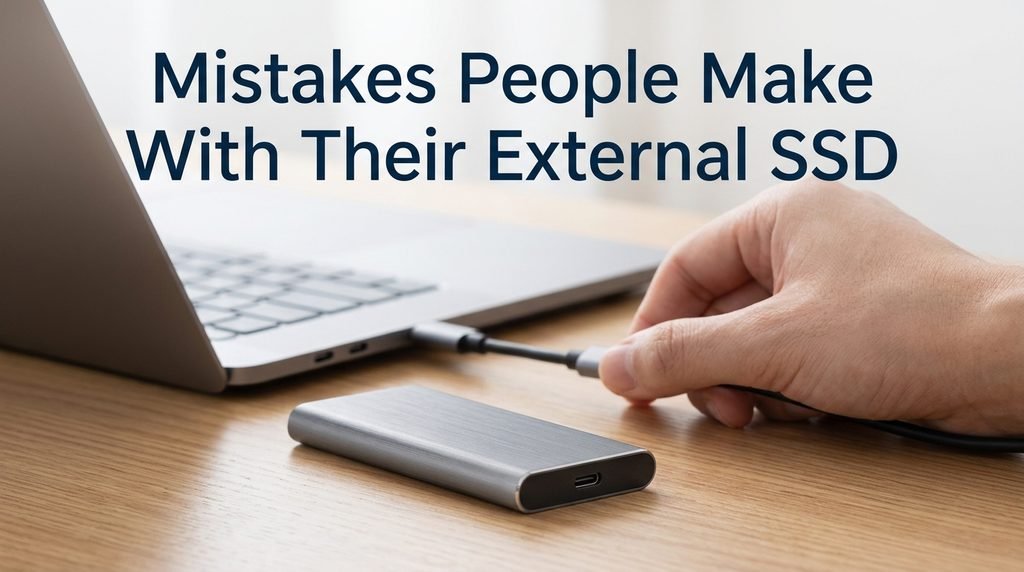
- Using the cable that came in the box for something else. Charging cables often aren’t rated for 10Gbps data transfer, and your external SSD for iPhone 17 Pro Max will underperform without you realizing why.
- Skipping the exFAT check. Buying an external SSD for iPhone 17 Pro Max pre-formatted in something else means reformatting it yourself — or dealing with compatibility errors on day one.
- Yanking the cable without ejecting first. This is the fastest way to corrupt a project file, especially right after a long recording session.
- Ignoring heat. A drive without cooling will throttle during extended 4K120 sessions, and that throttling shows up as dropped frames or recording errors.
- Trusting one copy of your footage. Drives fail. It happens rarely, but often enough that “just this once” backups aren’t worth the risk on paid work.
Keeping Your Footage Safe
Treat your drive like it could fail tomorrow, because eventually, one will.
- Keep at least two copies of anything important — one on the SSD, one somewhere else entirely.
- Offload footage to a computer regularly instead of letting the drive fill up and sit untouched for weeks.
- Avoid leaving the drive in direct sun or a hot car after a shoot; heat is harder on SSDs than most people assume.
- If your drive has a companion app, check its health status every few months. Catching a failing drive early beats losing a project.
- On paid work, the 3-2-1 rule holds up well: three copies, on two different types of storage, with one kept somewhere off-site.
FAQs
Does any external SSD work with the iPhone 17 Pro Max?
Not quite. An external SSD for iPhone 17 Pro Max needs to be exFAT-formatted, use USB-C, and hit the minimum sustained write speed for whatever resolution you’re shooting.
Can I record ProRes RAW without one?
No Apple only allows ProRes RAW recording when an external drive is connected. There’s no internal-storage option for it at all.
What speed should I actually look for?
220MB/s sustained for 4K60, and 440MB/s sustained if you’re shooting 4K120.
Will using an external SSD drain my phone’s battery faster?
Some drives pull power from the phone, yes. Others come with pass-through PD charging, so the phone can actually charge while you’re recording — worth checking before you buy.
Magnetic or cable-based — which should I pick?
Magnetic suits outdoor, handheld shooting where cables get in the way. Cable-based tends to run cooler and often costs less, which makes it a solid pick for studio work.
Conclusion
If you’re doing anything beyond casual video on the iPhone 17 Pro Max, a good external SSD for iPhone 17 Pro Max stops being optional pretty quickly. It buys you recording freedom the phone alone can’t offer, and over time it’s cheaper than either an iCloud subscription or Apple’s storage upgrade tax.
Check the write speed, confirm it’s exFAT, and pick a form factor that matches how you actually shoot — magnetic for movement, cable-based for stationary setups. Then back your footage up like the drive could die tomorrow, because someday, one will.
Related Post:
XPG Xenia G15 Upgrade SSD: 7 Proven Steps for 2026
2230 vs 2280 SSD: Which Size Fits Your Device (and Is One Faster?)
1TB vs 2TB SSD: Which One Do You Actually Need?